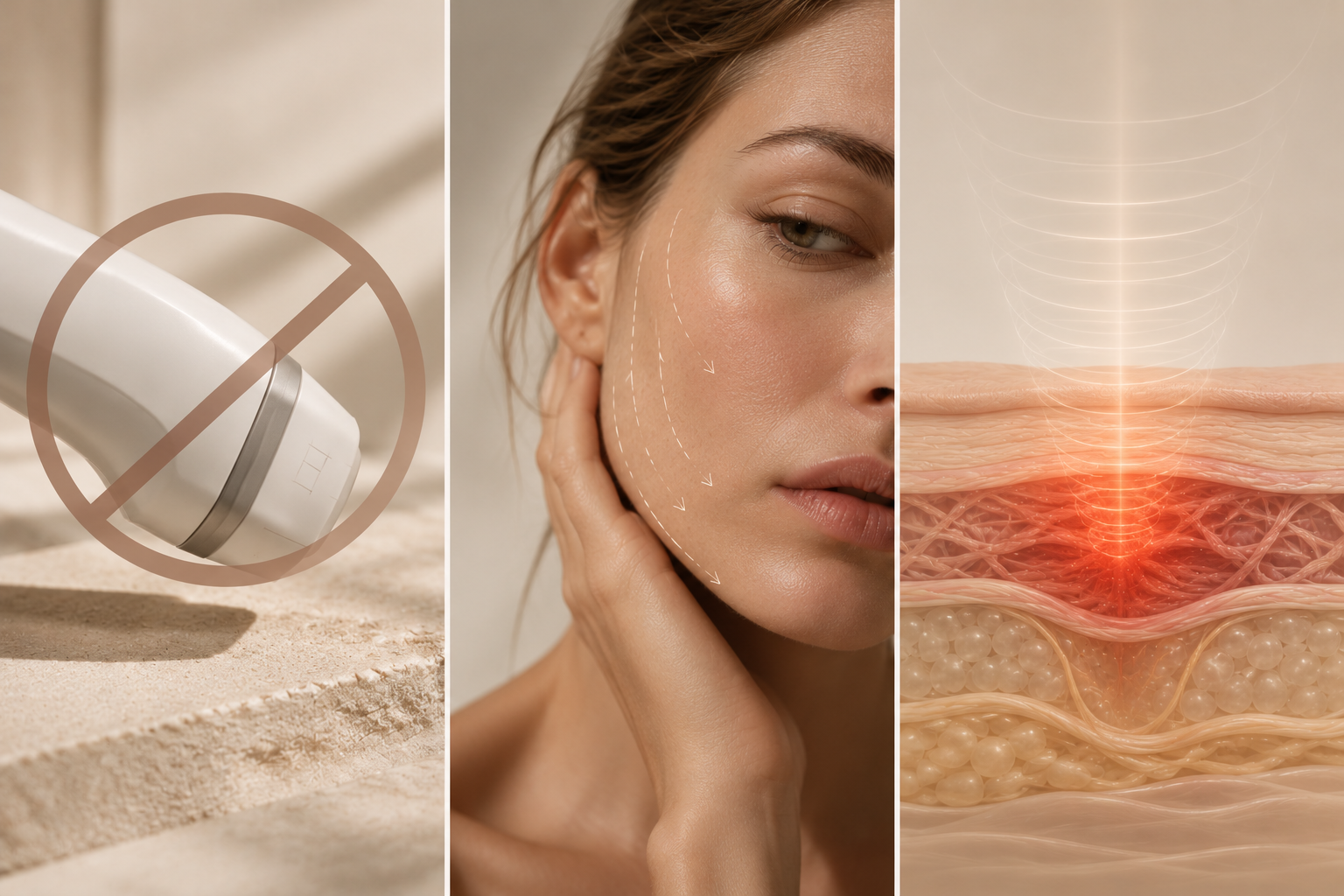
Is HIFU safe? Why we don’t offer this popular skin treatment

- 12 October 2026

HIFU is often presented as a straightforward way to lift and tighten the skin without surgery. No injections and little downtime. At Re-sult, however, we have consciously chosen not to work with HIFU. Here’s why.

What exactly does HIFU do?

HIFU stands for High-Intensity Focused Ultrasound. The device concentrates ultrasound energy at specific depths beneath the skin. This creates small areas in which the tissue is heated intensely. The resulting controlled thermal damage is intended to trigger a repair response and stimulate collagen production.

The technology can be effective for skin tightening. Research also shows, however, that results tend to be relatively moderate on average and that studies vary considerably in terms of the devices, energy settings and treatment protocols used.

Why are we cautious about HIFU?

HIFU delivers energy relatively deep into the tissue. The correct treatment depth, energy settings, anatomical knowledge and quality of the device are therefore particularly important.

The ultrasound imaging capabilities of the equipment also play an important role. With medical HIFU equipment, the practitioner can use ultrasound imaging to visualise the underlying tissue and better determine where the energy is being delivered. Non-medical HIFU devices, which are also frequently used in non-medical centres, often do not offer this capability.

This matters because deeper areas of the face also contain nerves and other structures that we do not want to affect. Being able to see the depth and tissue into which the energy is being delivered helps reduce the risk of complications such as nerve damage.

The most common side effects are temporary and include redness, swelling, tenderness and pain. More serious complications have also been reported.

A recent systematic review of the scientific literature identified, among other complications, a case of subcutaneous atrophy. Reports in the US MAUDE database have also included lipoatrophy, nerve damage, numbness, dysesthesia, ptosis and scarring.

Cases of blistering, ulceration, necrosis and atrophy of the skin or subcutaneous tissue following microfocused ultrasound have also been published. These serious complications are described as rare, but they are possible.

Unwanted volume loss is a particular concern for us

When treating facial ageing, skin laxity is only part of the picture. As we age, we naturally lose volume as well.

Unwanted loss of subcutaneous tissue is therefore exactly what we want to avoid. At Re-sult, this makes us cautious about technologies that concentrate energy at greater depths and for which atrophy has been described as a possible complication.

Why Re-sult chooses other technologies

We prefer to work in a controlled way on skin quality, collagen, elastin and skin firmness, combining different technologies according to what the skin needs.

With Venus Viva multipolar radiofrequency and PEMF, we use controlled heat in the dermis. The skin temperature is continuously monitored during treatment, allowing us to work specifically on processes involving collagen, elastin and hyaluronic acid.

With Venus Viva nanofractional radiofrequency and microneedling, we can work more intensively on skin texture, wrinkles, scars and skin renewal.

With Mesolux + TDX20, we use transdermal electroporation to deliver selected active ingredients further through the skin barrier. Dermalux MD uses specific wavelengths of medical LED light to support processes including skin recovery and overall skin quality.

The technology or combination we choose depends on the skin, age, degree of skin laxity and what the client wants to improve.

HIFU can produce results and is used worldwide. At Re-sult, however, the potential disadvantages and the level of control we want to maintain over the tissue being treated are sufficient reasons for us to consciously choose other technologies.

It may be popular, but as far as we’re concerned, HIFU is not a treatment we recommend.

Share post:

Related Techniques

Multipolar radiofrequency with magnetic waves
Nanofractional radiofrequency

Lopende promo