From epidermis to dermis: which skin treatment works at which depth?

- 11 November 2026

A chemical peel, microneedling, LED therapy or radiofrequency treatment can all improve your skin, but each technology works differently and at a different depth. How we deliver active ingredients into the skin also plays an important role.

Our skin consists of several layers, each with its own structure and function. Choosing the right treatment depends on where the skin concern originates, which processes we want to influence and what your skin needs at that particular moment.

First, a closer look at the layers of your skin

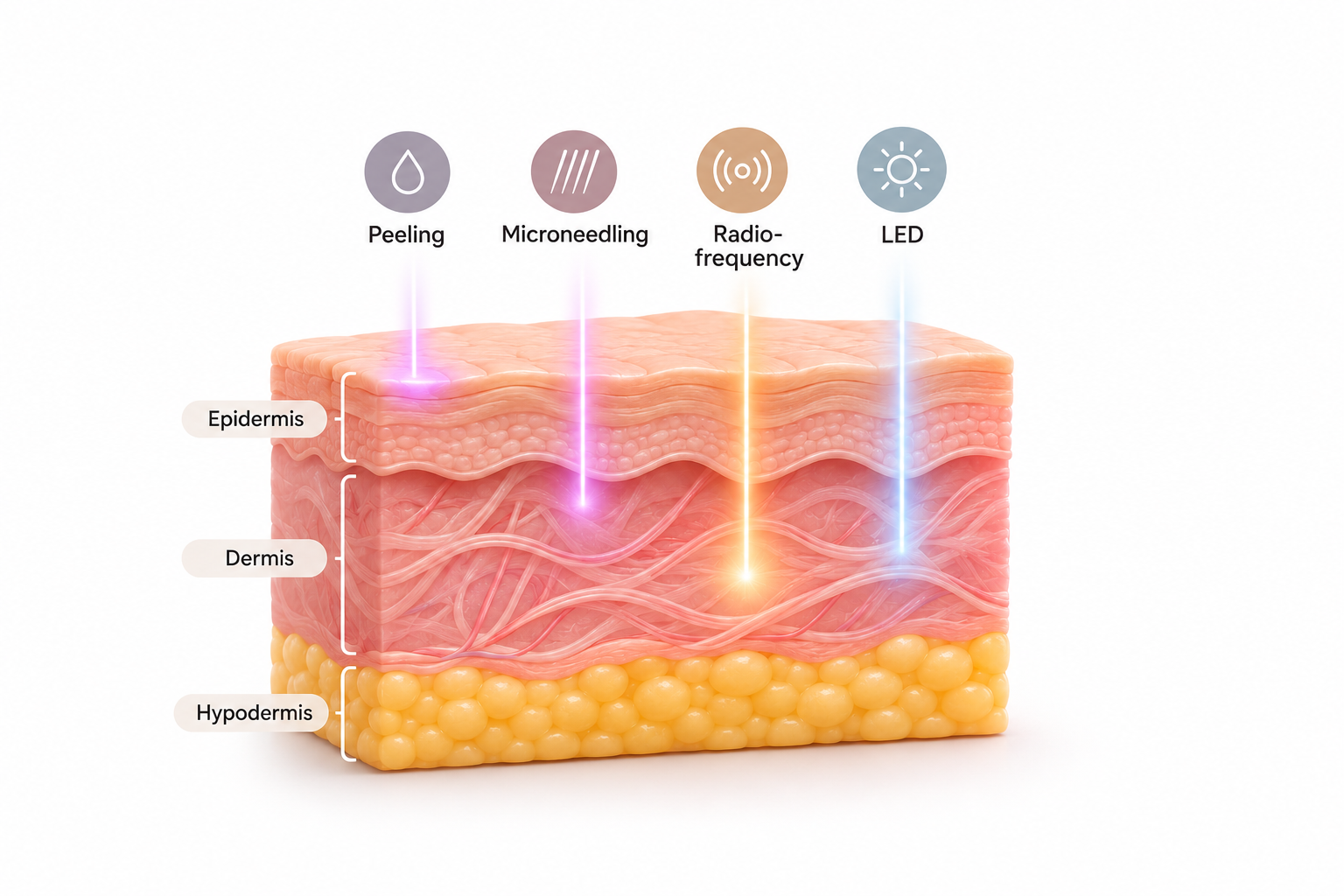
The epidermis is the outermost layer of the skin. Its top layer, known as the stratum corneum, forms an important part of our skin barrier. The epidermis contains several types of cells, including keratinocytes and melanocytes, which produce melanin.

Beneath the epidermis lies the dermis, divided into the more superficial papillary dermis and the deeper reticular dermis. This is where we find fibroblasts, collagen and elastin fibres, blood vessels, nerves, sebaceous glands, sweat glands and hair follicles.

Fibroblasts play an important role in producing collagen, elastin and hyaluronic acid. Unlike certain other cells in the body, such as brain cells, these skin cells can also be reactivated and regenerated.

Below the dermis is the hypodermis, the subcutaneous layer made up largely of fatty tissue.

These differences in structure and depth explain why we use different technologies to treat pigmentation, acne, wrinkles, scars and skin laxity.

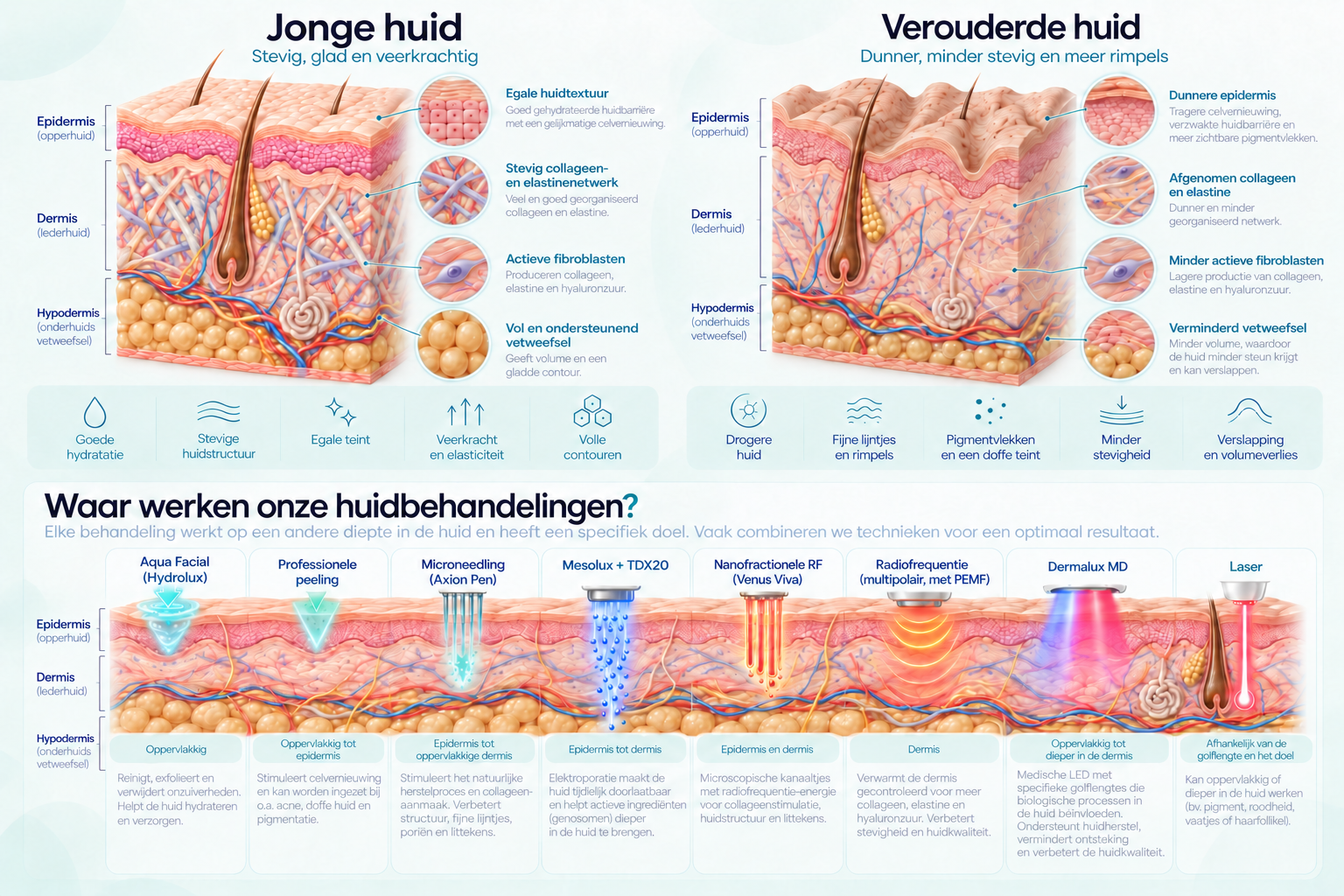
Young and aged skin comparison

Aqua Facial / Hydrolux: working at the skin's surface

An Aqua Facial or Hydrolux treatment primarily targets the outermost layer of the skin. During the treatment, we cleanse and exfoliate the skin, remove accumulated dead skin cells and impurities using vacuum suction and simultaneously infuse restorative and hydrating boosters. These may also include exosomes.

The treatment gives the skin a boost, restoring a fresh, healthy glow while improving its resilience during seasonal changes.

It's particularly suitable for dull or dry skin, superficial impurities and anyone looking for a fresher, more hydrated complexion.

Professional chemical peels: working within the epidermis

Professional chemical peels use carefully selected acids to stimulate skin renewal. They can also help restore the skin's microbiome, an important part of its natural protective barrier.

The intensity of a peel depends on several factors, including the type of acid, its concentration, pH and contact time. We use chemical peels to address acne, clogged pores, pigmentation, dullness, fine lines and uneven skin texture.

At Re-sult, we work with professional peels from brands including Celestetic and Mesoestetic. We select the appropriate acid and treatment intensity based on your skin condition and the concerns we want to address.

After a peel, we always use Dermalux MD to support skin recovery and reduce downtime. In certain cases, we can also combine a peel with microneedling to improve the delivery of active ingredients. We assess whether this combination is appropriate for your skin beforehand.

Microneedling with the Axion Pen: from the epidermis to the superficial dermis

Microneedling uses very fine needles to create microscopic channels in the skin. At Re-sult, we work with the Mesoestetic Axion Pen, reaching a maximum depth of 0.5 mm.

This stimulates the skin's natural repair processes and the mechanisms involved in producing new collagen.

Microneedling can help improve fine lines, pigmentation, enlarged pores, uneven skin texture and superficial scars. We can also combine the treatment with tailored boosters or professional peels to target specific skin concerns more effectively.

Mesolux: delivering active ingredients into the dermis

With Mesolux by Sisneo Bioscience, we use a technology called transdermal electroporation. Electrical pulses temporarily increase the skin's permeability, allowing selected active ingredients to pass further through the skin barrier without needles or injections.

We work with ingredients including exosomes and lipid-based boosters. These boosters contain active ingredients with a higher molecular weight and send signals to fibroblasts, encouraging them to function more effectively at an oxidative level.

Molecular size is particularly important here. After all, our skin barrier is designed to keep external substances out. When molecules cannot penetrate effectively, active ingredients remain largely on the surface rather than reaching the intended skin layer.

That's why, at Re-sult, we pay close attention to the composition and molecular size of the boosters, as well as the technology used to deliver them. We chose Sisneo Bioscience because of the scientifically supported results behind its system.

Mesolux also has different treatment applicators, allowing us to work on smaller or more specific areas, including the delicate skin around the eyes, the scalp and certain areas of the body.

The treatment is further supported by LED light, which interacts with chromophores involved in cellular energy processes. This helps support processes associated with collagen, elastin and reducing inflammation.

We use Mesolux to address concerns including pigmentation, acne, dullness and premature skin ageing, with the aim of restoring healthier skin function and improving overall skin condition.

TDX20: a skin longevity treatment at cellular level

At Re-sult, we also combine Mesolux electroporation with TDX20 by Sisneo Bioscience, a new generation of skin-repair and anti-ageing technology focused on skin longevity.

One of the biggest challenges with active skincare ingredients is getting them into the skin. According to this technology, conventional applications of ingredients such as liposomes, peptides and exosomes achieve only around 1% penetration. With TDX20, absorption can reach 20%.

What makes TDX20 particularly interesting is that we prepare a personalised serum on the spot. The active ingredients are processed into genosomes and then centrifuged in the XGEN Reactor. During this process, the genosomes undergo a mechanical shock that significantly increases and stabilises their ability to transport active ingredients to fibroblasts.

We deliver half of this personalised longevity elixir into the skin during the treatment using electroporation. You take the other half home as a concentrated serum, applying it morning and evening for four weeks.

This allows us to continue working on the skin cells long after the treatment itself. The active ingredients send signals to fibroblasts, helping the cells regain energy, function more effectively and remain in good condition for longer.

TDX20 is a comfortable treatment that can also produce immediately visible results. We use it to improve skin quality and support processes involved in skin ageing and cellular repair.

Nanofractional radiofrequency: working within the epidermis and dermis

With Venus Viva, we combine microscopic channels with radiofrequency energy. This treatment works within both the epidermis and dermis and can also complement a skin longevity programme involving TDX20.

The nanofractional tip creates 160 microscopic channels in the skin while simultaneously delivering radiofrequency energy into the tissue. This stimulates the skin's natural repair processes and the production of new collagen.

An important feature of the technology is its controlled heating of the skin, which we monitor using the integrated ultrasound system.

In terms of results, the treatment is comparable to a CO₂ laser, but without the associated downtime and discomfort. Under normal circumstances, the skin has recovered within 24 hours and any redness has disappeared.

We use nanofractional radiofrequency to treat acne scars, enlarged pores, deeper wrinkles, skin laxity, pigmentation and uneven skin texture.

Multipolar radiofrequency with PEMF: controlled heating within the dermis

Multipolar radiofrequency allows us to work within the dermis without penetrating the skin with needles. We use controlled heat to stimulate processes involving collagen, elastin and hyaluronic acid.

With Venus Viva, we combine multipolar radiofrequency with PEMF (Pulsed Electromagnetic Fields). During the treatment, we heat the tissue to approximately 39–41°C, monitoring the temperature with medical ultrasound.

The combination of controlled heat and electromagnetic pulses works at cellular level. Skin cells are reactivated and regenerated while telomeres do not shorten, allowing the cells to survive longer and continue functioning properly.

This makes the technology particularly interesting for our skin longevity treatments, including in combination with TDX20.

We primarily use multipolar radiofrequency with PEMF to address skin ageing, loss of firmness and reduced skin quality. Another advantage is that clients generally find the treatment very comfortable.

Dermalux MD: different wavelengths of light

With Dermalux MD, we use medical-grade LED technology with three different wavelengths: 415 nm blue light, 633 nm red light and 830 nm near-infrared light.

Each wavelength has different properties and penetrates the skin to a different depth. Blue light works closer to the surface, while red and particularly near-infrared light penetrate deeper.

We use Dermalux MD to support skin recovery, reduce inflammation and stimulate processes associated with skin rejuvenation. The technology can be used for various concerns, including acne, melasma, rosacea and hair loss.

Dermalux MD is a medical LED system that stands apart from conventional LED devices because of its extremely low power loss, allowing for highly efficient light delivery.

We can use Dermalux MD as a standalone treatment, but we also incorporate it after other procedures, such as chemical peels, to shorten recovery time and support skin repair.

Because each wavelength penetrates to a different depth, LED therapy cannot be assigned to one fixed layer of the skin.

Why we combine different technologies

Skin ageing takes place at several levels. At the surface, the skin may become drier, duller or more uneven. Within the dermis, collagen and elastin levels change, along with fibroblast activity. The underlying fatty tissue and facial contours also change with age.

That's why, at Re-sult, we combine different technologies depending on what we want to treat. A chemical peel primarily works within the epidermis, while microneedling and nanofractional radiofrequency can be used more specifically to improve skin texture and stimulate collagen production.

With Mesolux and TDX20, we can deliver selected active ingredients at cellular level and work on skin longevity. Multipolar radiofrequency with PEMF allows us to work within the dermis using controlled heat, while Dermalux MD uses different wavelengths to support skin repair, reduce inflammation and encourage skin rejuvenation.

During a skin consultation at Re-sult, we first assess what's happening within your skin, which layers are involved and what you'd like to improve. Based on that analysis, we select the technologies and combinations that best suit your personalised treatment plan.

Related treatments

No data was found
Share post:

Related Techniques

Aqua Facial
behandeling met dermaneedling of microneedling
Microneedling
Multipolar radiofrequency with magnetic waves
Nanofractional radiofrequency
gelaatsbehandeling met peeling
Professional peeling

Lopende promo