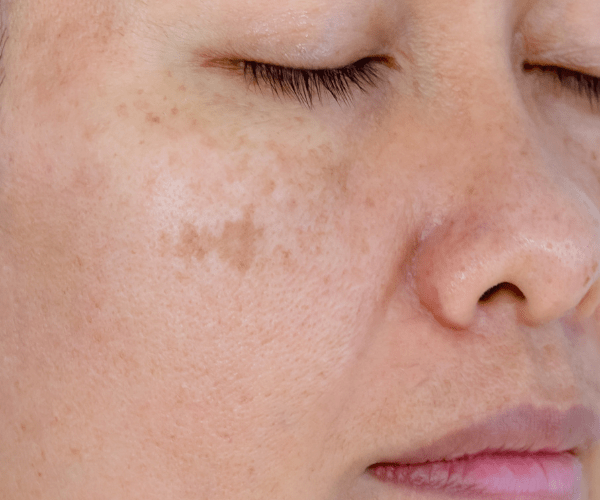
The colour of our skin is partly determined by melanin, the pigment produced by melanocytes in the skin.
Melanin has an important function: it helps protect the skin against UV radiation. When melanin production increases in certain areas, darker patches or spots can become visible.
UV exposure is one of the main contributing factors. Years of sun exposure can eventually lead to pigmentation, particularly on the face, neck, décolletage and hands.
Hormonal changes can also play a role. A well-known example is melasma, sometimes referred to as the ‘mask of pregnancy’. It often appears as larger, irregular areas of pigmentation on the face.
Oestrogen can make melanocytes more sensitive and stimulate melanin production. Progesterone also has an influence. During pregnancy, MSH, or melanocyte-stimulating hormone, plays an important role as well.
It is important to understand that hormones do not simply determine how much pigment is produced. They mainly influence how strongly melanocytes respond to external factors, such as UV radiation. Hormonal changes can therefore make the skin much more sensitive to developing pigmentation.
Genetics also influence how prone someone is to pigmentation.
Inflammation or damage to the skin can leave pigmentation behind as well. A common example is a dark mark that remains after a spot or other inflammation has disappeared.
At Re-sult, we therefore look beyond the visible pigmentation. We assess the type of pigmentation as well as the overall condition of the skin.